What is rice shochu?
Rice shochu (米焼酎) is a honkaku shochu made from rice and rice koji. Soft and gently sweet. Kuma shochu from the Hitoyoshi-Kuma area of Kumamoto (GI Kuma) is the classic. The 291 rice shochu bottles with a price on KIKI have a median of ¥1,430 per 720 ml (as of 16 Nov 2026).
- Rule
- Single distillation (honkaku)
- Made from
- Mainly rice
- On KIKI
- 291 bottles
- Median per 720 ml
- ¥1,430
Is rice shochu distilled sake?
No. Both start from rice and rice koji, but they part halfway. Sake is pressed to separate the liquid from the lees, while rice shochu sends the whole mash through a pot still. The koji differs too. Sake normally uses yellow koji, rice shochu mostly white or black, which make plenty of citric acid and keep the mash safe in Kyushu's warmth.
Of the 109 rice shochu in KIKI with known koji, 59% use white, 21% yellow and 19% black (October 2026). Yellow koji brings it closer to sake. In KIKI's taste data, "aromatic" appears for 43% of yellow-koji bottles and 5% of black-koji ones.
What makes rice shochu labelled "Kuma" different?
Kuma is the geographical indication for rice shochu from Hitoyoshi City and the Kuma district of Kumamoto, designated on 30 June 1995 with Iki and Ryukyu. It allows only Japanese rice and koji made from it, local water, and fermentation, distillation, storage and bottling in the area.
The national standard describes a basin ringed by mountains, cold in winter for its latitude, with wide day and night swings, frequent thick fog and soft water from the Kuma river. Being remote, it is said to have kept its rice even in famine years, when other areas turned to other ingredients.
Of the rice shochu in KIKI, 41% comes from Hitoyoshi and Kuma.
How does the still change it?
The Kuma standard says atmospheric distillation gives a toasty, rice-like aroma and vacuum distillation a fruity one. Think of the crust of rice at the bottom of the pot, or something light like ginjo sake.
Of KIKI's rice shochu with a known still, 65% are vacuum-distilled. Of those, 31% are "aromatic" and 26% "fruity", against 2% and 0% for atmospheric bottles, which are "aged" (45%) and "full-bodied" (39%) instead. Start light, and go atmospheric if it feels thin.
Is rice shochu made outside Kyushu?
Yes. KIKI lists it from 34 prefectures, and 34% comes from outside Kyushu, against 5% for sweet potato shochu. In Fukushima, Okayama, Niigata, Nagano and Kyoto, sake breweries make it too. Of the 59 bottles that name their rice, 18 use a sake rice such as Yamada Nishiki or Gohyakumangoku, seven of them from Fukushima.
How do you drink it?
Of the rice shochu in KIKI with serving advice, 90% recommend it on the rocks and 38% neat, against 24% neat for sweet potato shochu. Bottles at 35% or more make up 28%.
Drink a light one on the rocks or 6 to 4 with cold water. With an atmospheric or aged one, sip it neat first, then try hot water, which lifts the sweet rice aroma. Of the bottles with a known way of ageing, 24% spent time in barrels, and some are aged 20 years or more.
It suits most Japanese food, such as white-fish sashimi, tofu, simmered root vegetables or anything grilled with salt.
Sources: 国税庁「別紙 地理的表示『球磨』生産基準」, 国税庁「酒類の地理的表示一覧」, 東京国税局「焼酎に関するもの」
Which rice shochu do shops stock most?
The rice shochu bottles sold by the most shops.


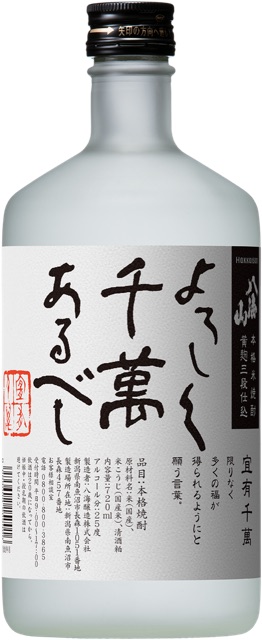 Hakkaisan Yoroshiku Senman Arubeshi Authentic Rice Shochu Yellow Koji 3-Stage FermentationRice shochu¥2,500 1.8 L

How much does rice shochu cost?
Most rice shochu costs ¥1,000–2,000 per 720 ml (126 bottles), and the median is ¥1,430.
- under ¥1,00069
- ¥1,000–2,000126
- ¥2,000–3,00041
- ¥3,000–5,00039
- ¥5,000–10,00012
- ¥10,000 and up4
What does rice shochu taste like?
Across 95 bottles with taste data it averages balanced and medium-bodied, and the words used most are “mellow”, “aged”, “depth”, “rice umami”, “oak” and “clean”.
- Dry ↔ sweet
- balanced
- Light ↔ rich
- medium-bodied
Where is it made?
Where the rice shochu bottles on this site come from (bottles per prefecture):
Rice shochu bottles
About Rakuten prices
Rakuten Ichiba prices were checked on each shop's page on or after 14 Nov 2026.
The information on this site is run by the creator of KIKI (kiki-sake.com). Prices and availability may change. The price shown at the Rakuten Ichiba shop (www.rakuten.co.jp) at the time of purchase applies to the sale.
Learn more
- Types of shochu and awamori
- Popular kome (rice) shochu ranking
- Glossary
- Price dataMedian price per 720 ml by grade, base ingredient and prefecture
Other types
Sweet potato shochuBarley shochuBrown sugar shochuBuckwheat shochuSake lees shochuShochu