
How KIKI’s numbers work
KIKI’s rating, taste profile, taste match, value score and prices are worked out by the same rules for every bottle, from a database built one bottle at a time from the breweries’ own websites and from shop prices checked every day. No commission or advertiser ever moves a score or an order (as of 16 Nov 2026).
- 27,000+bottles
- 1,500+breweries & distilleries
- 18,000+with real taste data
- 14,000+with the brewery’s list price
- 100,000+shop listings tracked
- 45,000+label fingerprints for the scan
What do all of KIKI’s numbers have in common?
Four rules: the same calculation for every bottle, primary sources first, no number when the data is too thin, and no money that moves a number.
- Same calculation: a famous brand and a tiny local brewery are scored by the same rules. Nobody reorders a list by hand.
- Primary sources first: what the brewery says on its own website wins over shop descriptions and other sites.
- No guessing: when there is not enough to compare, there is no number, and an estimate is always marked as one.
- Money moves nothing: the order of shops, ratings, value scores and recommendations never depend on whether or how much commission KIKI receives (Terms, Article 11.2). The same holds for taste match.
How is the rating worked out?
The “Rating” on a bottle combines the ratings KIKI users give it with the shop reviews on Rakuten Ichiba and Yahoo! Shopping, on one 1–10 scale. Shop reviews use five stars, so they are put on the ten-point scale first.
- A KIKI rating comes from someone who rated the bottle itself, so it counts for more than a single shop review. The more people rate on KIKI, the more KIKI’s own ratings carry.
- A bottle with only a few ratings is treated with caution, so one perfect review can’t put it at the top of a list.
- Only ratings from signed-in users count. Reviews hidden after reports are left out.
- A KIKI rating counts the moment it is given. Shop reviews are refreshed regularly with the shop data.
How are the five taste lines worked out?
Labels and shop pages describe taste in words (tanrei, rich, fruity) and in specs such as SMV and acidity. KIKI turns both into five lines: dry ↔ sweet, light ↔ rich, aroma, umami and acidity. Because the lines are the same for sake, shochu and awamori, any two bottles can be compared side by side.
- When the SMV (nihonshu-do) and acidity are known, the dry ↔ sweet line is calculated from them.
- AI reads the brewery’s and the shops’ descriptions of every bottle and keeps only what they say, most of it checked against the source text. The flavour words and serving tips come from the same texts. 18,000+ bottles have real taste data.
- Where information is thin, the app says plainly that it shows the typical taste of the type. Taste guessed from the type alone never appears on this website.
What does taste match compare?
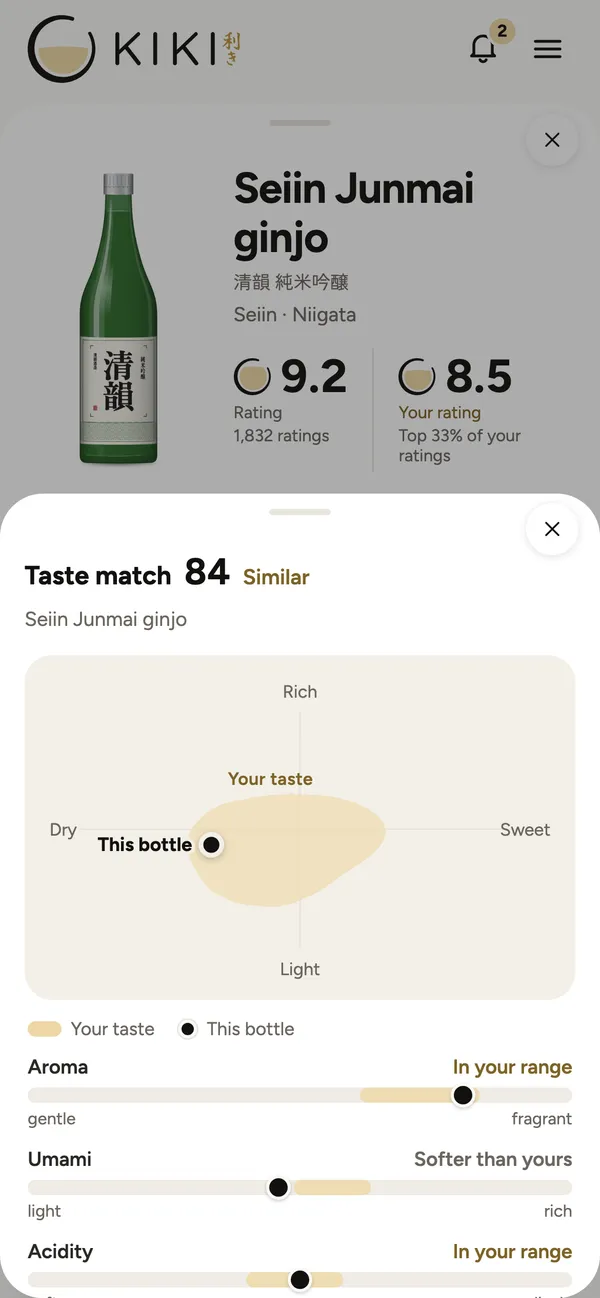
Taste match is a Premium feature. It learns your taste from the bottles you rate and favourite, then shows for every bottle how close it sits to that taste, as a number from 1 to 99 and a word: Spot on, Close, A bit different or Not your style. It works for bottles you have never tried.
- Spot on
- Similar
- A bit different
- Not your style
Tap the number and the taste match sheet opens: your range (gold) and where the bottle sits.
The screens are examples- Your taste is learned separately for sake and for shochu and awamori. It compares your range on the five taste lines, the grades, styles and flavour notes you keep choosing, and the bottles you rated low.
- Tap the number to see your range and the bottle on a taste map, with what fits, what differs and the bottle you rated that tastes closest.
- Prices, popularity, other people’s ratings and commissions play no part. Only your own taste decides.
- It starts once you have rated or favourited five bottles. With few ratings the numbers stay modest and the app says it is still learning. Every rating sharpens them.
What does the value score tell you?
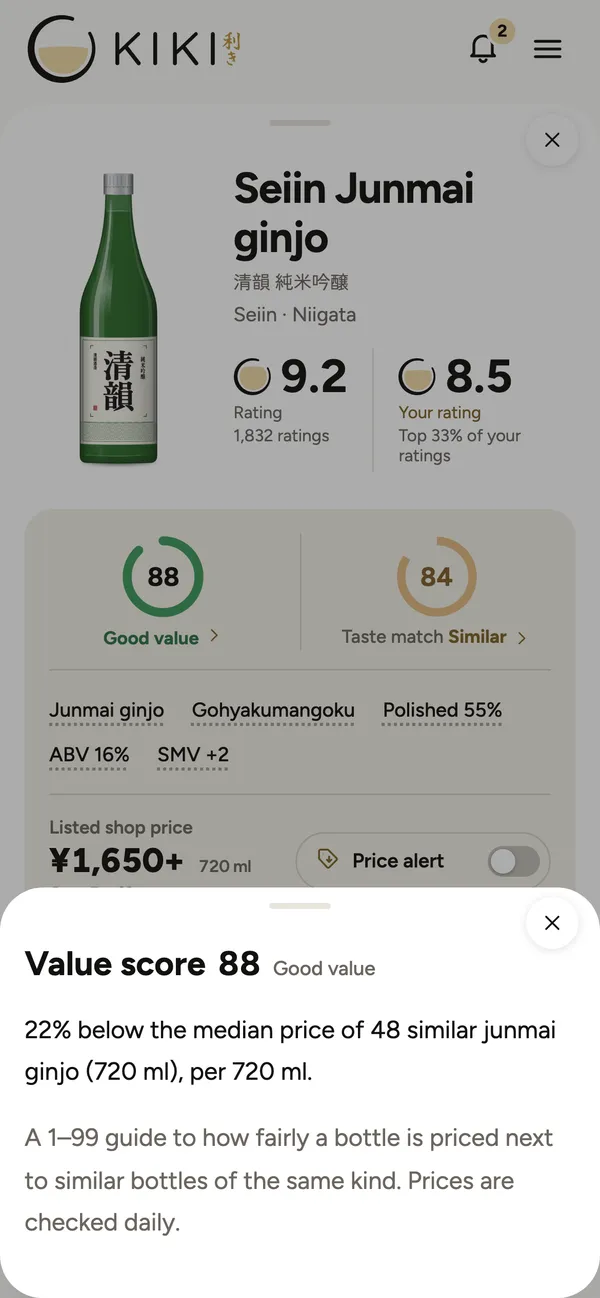
The value score is KIKI’s own 1–99 guide to how fairly a bottle is priced compared with similar bottles. Sake is compared with the same grade, polishing range and size, shochu and awamori with the same base, strength range and size, and aged or sparkling bottles only with their own kind.
- Good value
- Fair price
- Pricier
Tapping the score shows how many similar bottles it was compared with and how far it sits from their middle price.
The screens are examples- Prices are the listed shops’ single-bottle prices per 720 ml, checked daily. Shop reviews count a little; KIKI ratings count more as more people rate a bottle.
- Tap the score to see how many similar bottles it was compared with and how far its price sits below or above the middle.
- When shops ask far more than the brewery’s suggested price, the bottle is compared at the brewery’s price, so a reseller mark-up never makes a bottle look like a bargain or a rip-off.
- There is no score when too few similar bottles are listed or a price is far from every similar bottle.
- “Good value” and “Pricier” appear only when the difference is clear, otherwise “Fair price”. A bottle priced like similar ones scores about 70, good value 75 and up. It is a guide, not a promise of quality.
How are prices compared?
KIKI follows 100,000+ listings on Rakuten Ichiba, Yahoo! Shopping and breweries’ own shops and checks them in turn every day (each listing every one to three days). The app tells you when a price drops or a bottle is back in stock.
- To compare a 1.8 L and a 720 ml bottle fairly, prices are converted to 720 ml (1.8 L: price ÷ 2.5). Multi-packs count per bottle.
- Gift listings (engraved names etc.), furusato nozei and sold-out offers are left out.
- Every price carries the date it was checked. On the bottle page, a Rakuten price checked more than 24 hours ago shows as “Check at the shop” and is not used as the lowest price.
- “Lowest listed price” is the cheapest bottle of the shown size in stock, “per 720 ml” puts sizes on one scale, and the “median” is the middle value. Prices on this website are refreshed at least once a week.
What counts as a deal?
A deal appears only when the same listing in the same shop drops below its usual price. “Usually” is the median of the prices KIKI recorded for it every day over the last 30 days.
- A different shop or a different size being cheaper is never called a deal.
- Only listings with a long enough price record count. A newly found listing waits until its record has built up.
- Multi-packs, gift listings and seconds are left out, and so are prices far away from the brewery’s list price.
- Right before a deal is shown, KIKI checks again that the listing is still in stock, at that price, and still the cheapest for that bottle.
Why show list prices?
The brewery’s own price is the best yardstick for a shop price. KIKI collected the list prices of 14,000+ bottles from the breweries’ websites and shows how a shop price compares, size for size.
How are food matches chosen?
Each bottle gets its best matches out of 24 food tags in three groups: ingredients, cooking styles and seasonings. They are things you can put together at home (white fish, grilled, citrus) rather than restaurant dishes.
- Fixed rules score them from the type and grade, the making (kimoto / yamahai, nama / genshu, nigori, sparkling, aged …), the shochu base and koji, ageing and the taste lines.
- Dishes that the shop or brewery recommends count too.
- Every bottle is scored by the same rules, so matches are comparable from one bottle to the next.
How is the KIKI database built?
It starts from official sources: the Japan Sake Awards results, the National Tax Agency’s corporate numbers, brewers’ association directories and the lineups on the breweries’ own websites. That is how local bottles you won’t find on online marketplaces made it in, one by one (12,000+ of them).
- Several breweries share a name across prefectures, so each maker is identified by its corporate number and address, never by its name alone.
- Spelling variants (會/会, 生酛/きもと …) are folded together so the same bottle never appears twice. Where a pair is unclear, a person decides it.
- This website publishes the bottles that have both taste data and a price, in batches (2,743 of 19,769 so far). The app finds all 27,000+ by their label.
How is the data checked?
As a rule, a value read by AI is used only after it has been found in the text of its source page. A value the page doesn’t state is dropped. A fact taken from any other website (neither the brewery nor a shop listing) is used only when two independent sites agree.
- When a shop or another site disagrees with the brewery’s own website, the brewery wins.
- In October 2026, 1,000 bottles picked at random were checked against the breweries’ pages. Less than 1% of the facts shown disagreed, and those were corrected.
- New bottles are checked automatically for duplicates and mix-ups between breweries, and anything doubtful goes to the KIKI team.
- Corrections from a brewery are checked and put in first.
How are the brewery profiles made?
For 1,200+ breweries and distilleries, KIKI reads their public pages, mostly their own website, and sums up the profile, history, character and visits. The text is written with AI, most of it checked quote by quote against its source page, and the sources are listed. Awards come from the official Japan Sake Awards results (National Research Institute of Brewing).
How are the shops ordered?
KIKI doesn’t sell alcohol, so it has no favourite shop. Shops are listed by the price of one bottle of the shown size, and by shop name when prices are equal. Affiliate links are marked “PR” and never change the order.
What can’t KIKI’s numbers tell you?
Every number is a guide for choosing. Taste is read from descriptions and specs, and the same bottle can change with the brewing year and how it was kept. A rating reflects the taste of the people who gave it, and shops set their own prices, which change all the time. The value score is about price, not a promise of quality. The last word belongs to your own palate.