

Maewari, kurojoka and the 6:4 rule: how Kagoshima drinks imo shochu
In Kagoshima, imo shochu is usually mixed, not sipped straight: with water a day ahead (maewari), with hot water poured first for a 6:4 oyuwari, or warmed in a black clay kurojoka pot.
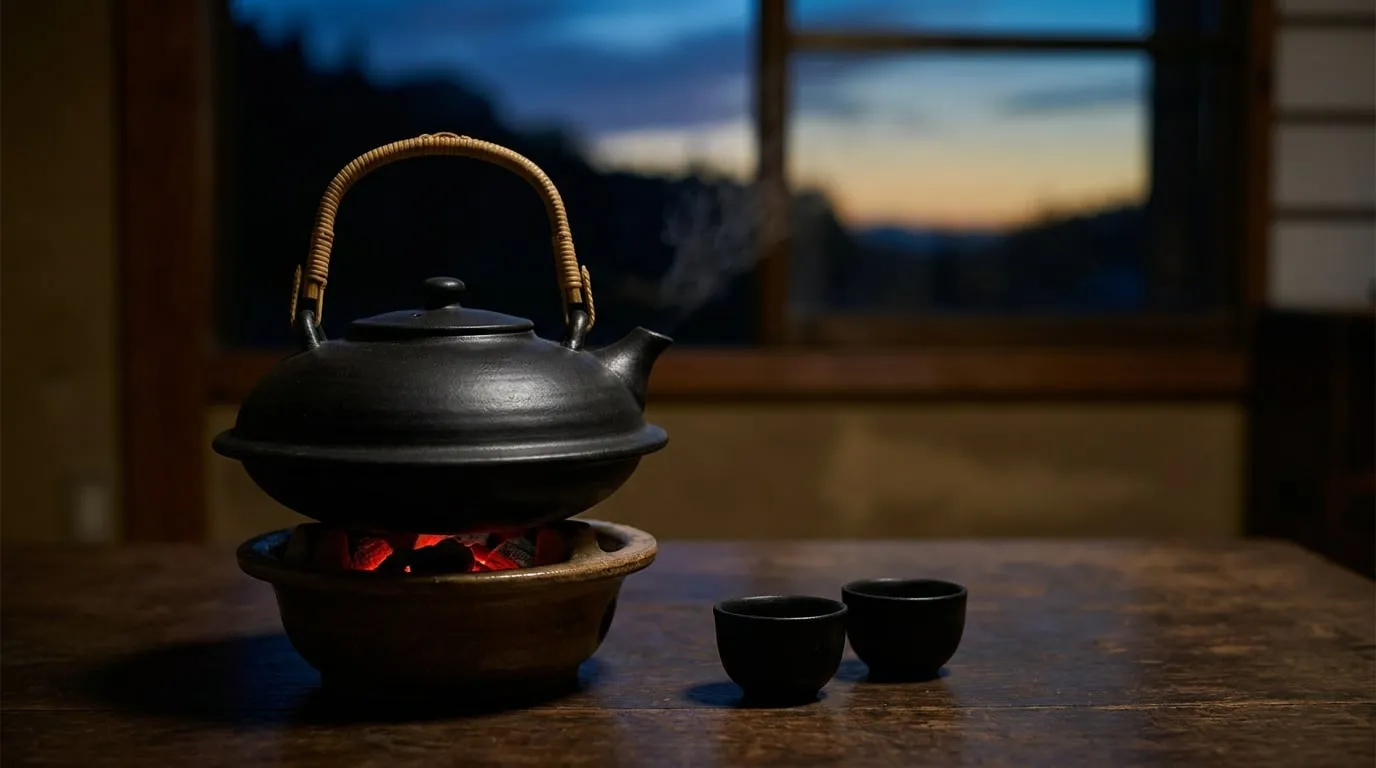
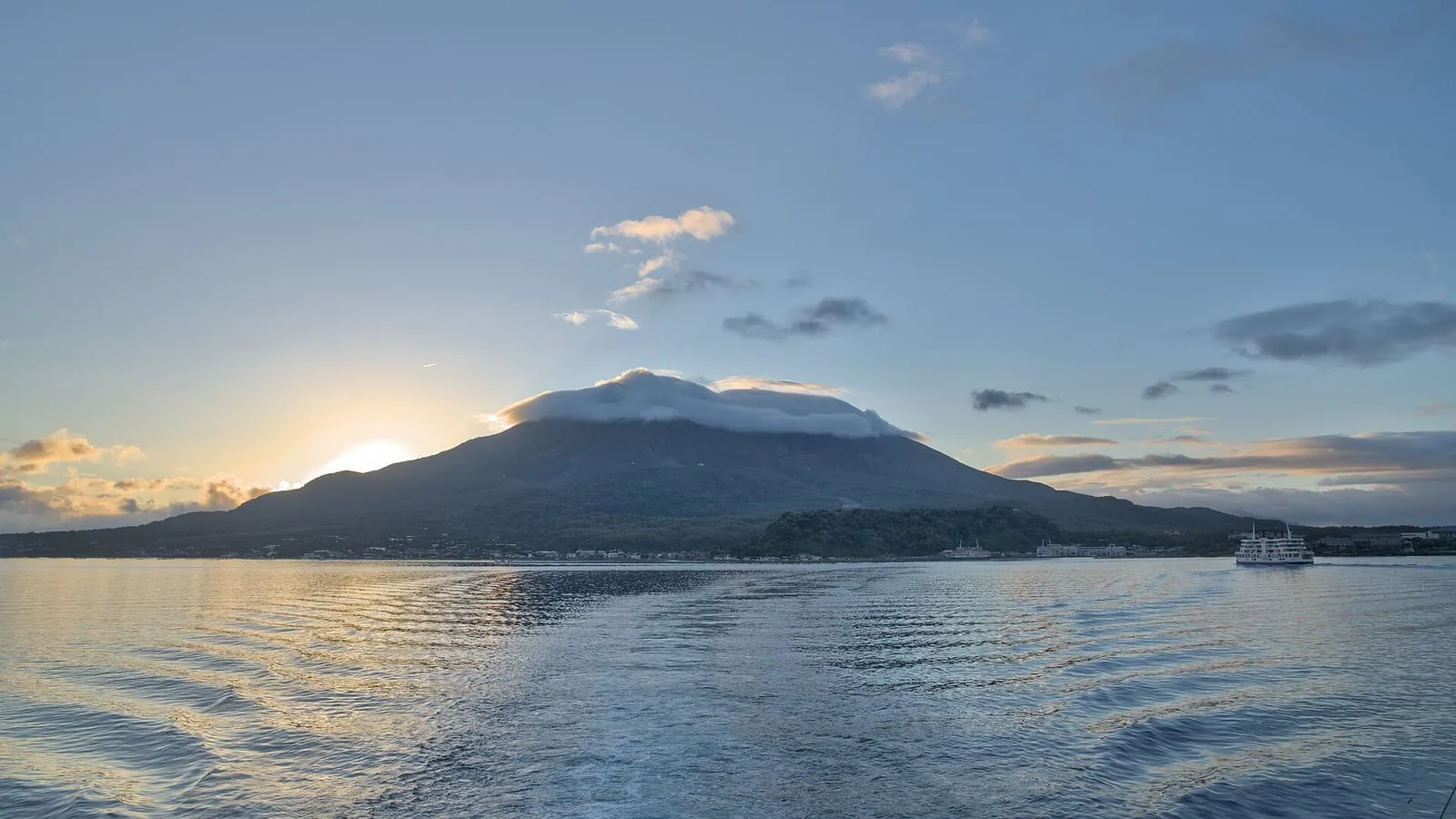
In some izakaya (casual Japanese pubs) in Kagoshima, the city at the southern tip of Kyushu, in the shadow of the volcano Sakurajima, the glasses on the counter have a line drawn across them and "5:5" printed beside it, a hint of how much shochu and how much hot water go in. A newcomer's account on the town of Higashikushira's blog says a night out here lasts about three hours as standard, that most people start with a beer, and that after that it is shochu to the end.
Shochu is Japan's distilled spirit, usually 25% alcohol, and the classic kind here is imo shochu, made from sweet potatoes.
Oyuwari, hot water first, at 6:4
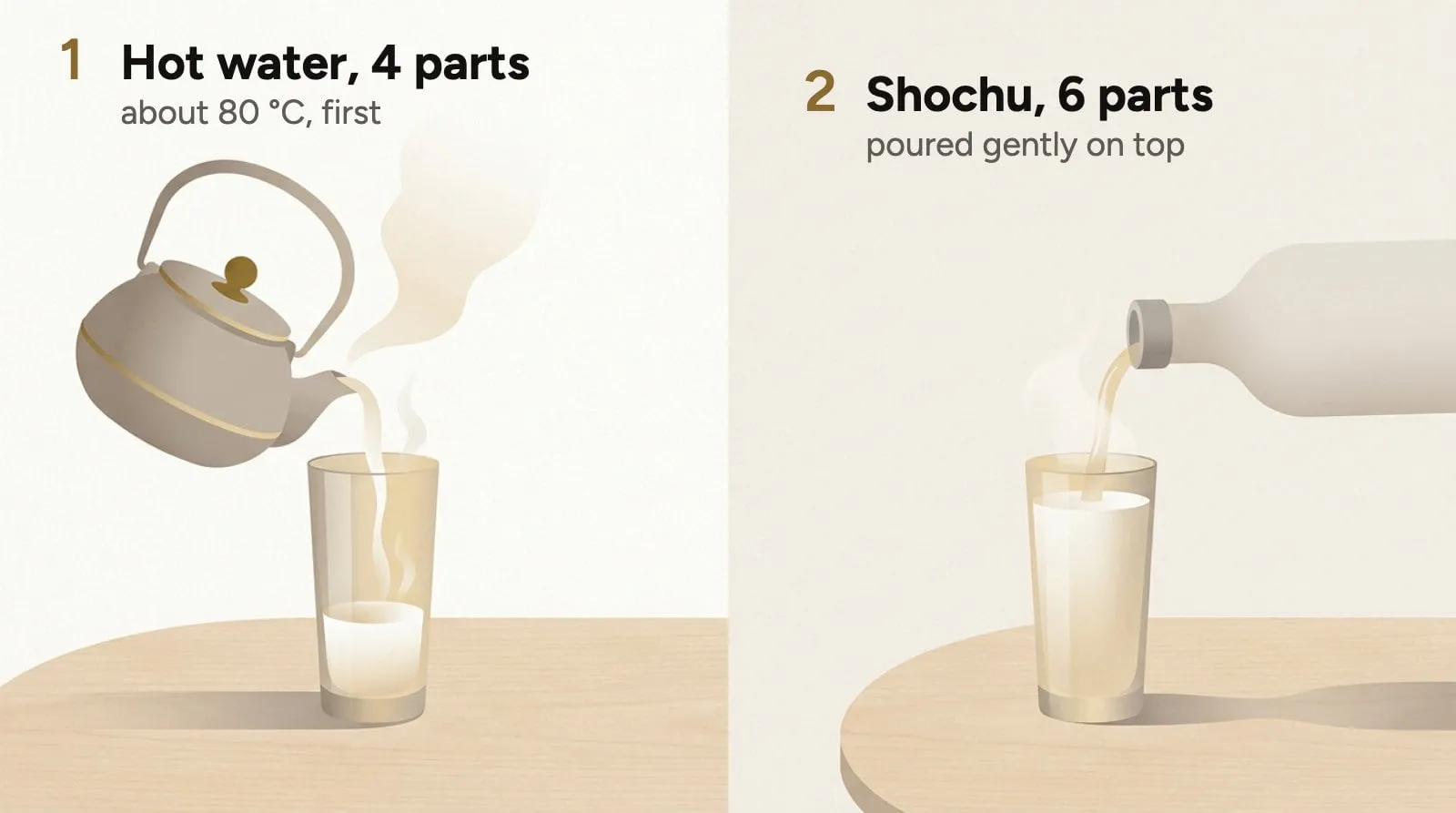
The everyday drink is oyuwari, shochu with hot water. Satsuma Shuzo, a well-known Kagoshima distiller, describes the standard mix as six parts shochu to four parts hot water. Locals call it rokuyon, "six-four". With a 25% shochu that comes out at about 15%, close to the strength of sake (see our guide to mixing shochu for a table).
The order matters: hot water goes in first, shochu second. The official Kagoshima tourism site suggests hot water at around 80 °C poured into the cup first, then the shochu added gently. The Kagoshima city tourism site explains that the steam carries the shochu's sweetness and aroma up to your nose.
It is not a strict law, though. A bartender quoted on the Kagoshima distillers' association site says both orders are fine in Kagoshima. Hot water first tends to bring out sweetness, shochu first a drier edge. And the ratio itself is casual: some people say go-go (5:5) instead. The Higashikushira account notes that people disagree whether the "6" in six-four means the shochu or the water.
Maewari, mixed the day before
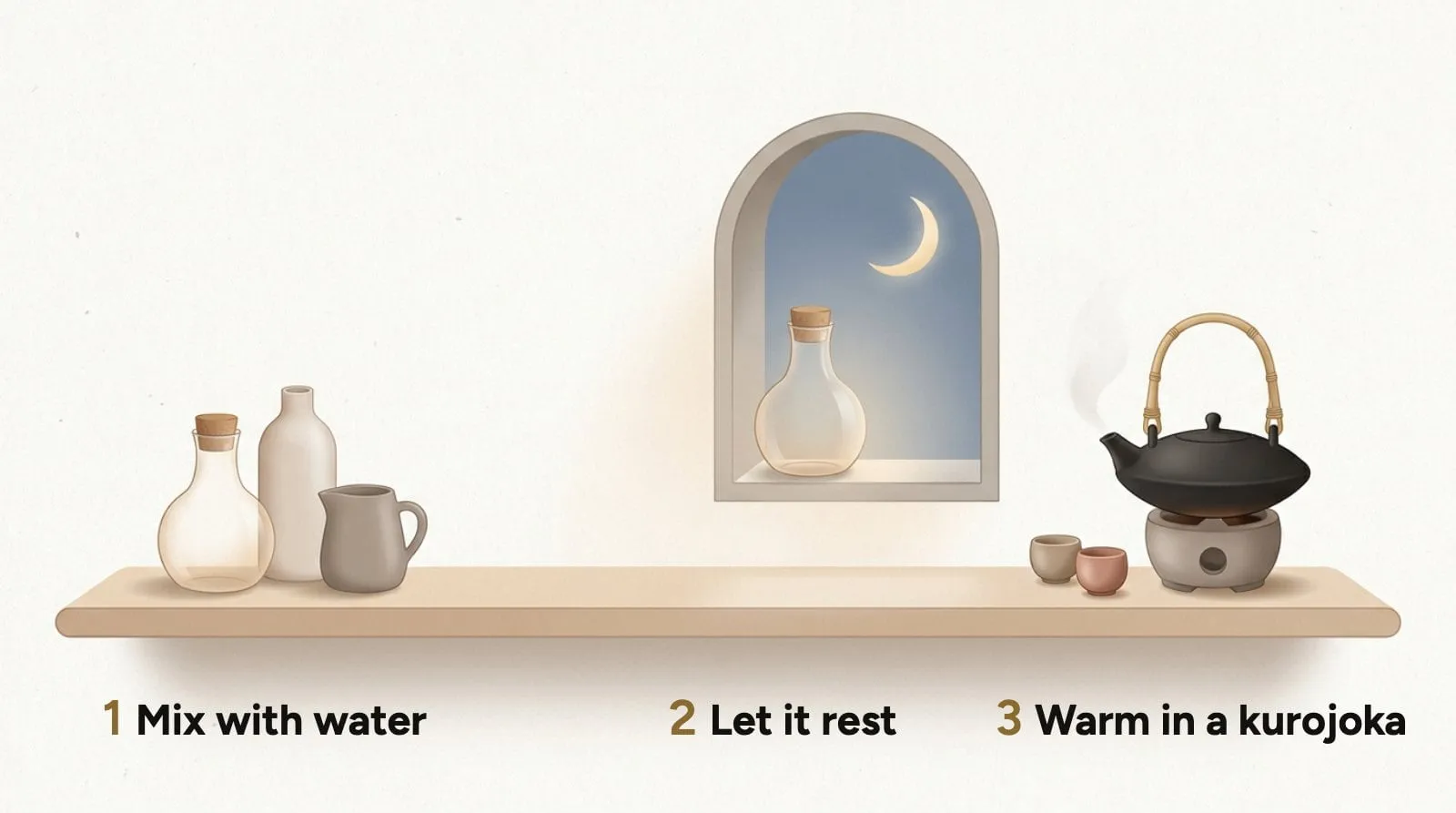
The most Kagoshima thing of all is maewari, "front mixing". You blend shochu and water in the ratio you like, then let it rest. Okuchi Shuzo, a distillery that runs its own shochu bar, says anything from one night to a week works, ideally three to seven days, with 6:4, 5:5 or 4:6 as the usual ratios. Keep it away from direct sunlight.
It is also a form of hospitality. When guests are coming, a Kagoshima host starts preparing days ahead, so the shochu is ready and gentle when they arrive. Distillers explain that the water and shochu settle together and the sharp edge of the alcohol softens. The idea is that the host does the waiting so the guest does not have to.
You can drink maewari chilled, on ice, or warmed. Some Kagoshima bars serve it by the glass, and one article notes it can be ordered on the rocks or warmed.
The kurojoka, a clay pot for warming
Maewari is at its best in a kurojoka, a black, flat-bodied clay pot with a spout and a handle. "Choka" is Kagoshima dialect for a teapot, and the Kagoshima distillers' association says the pot's sturdy shape is sometimes linked to Sakurajima. It also appears on the official Satsuma shochu mark.
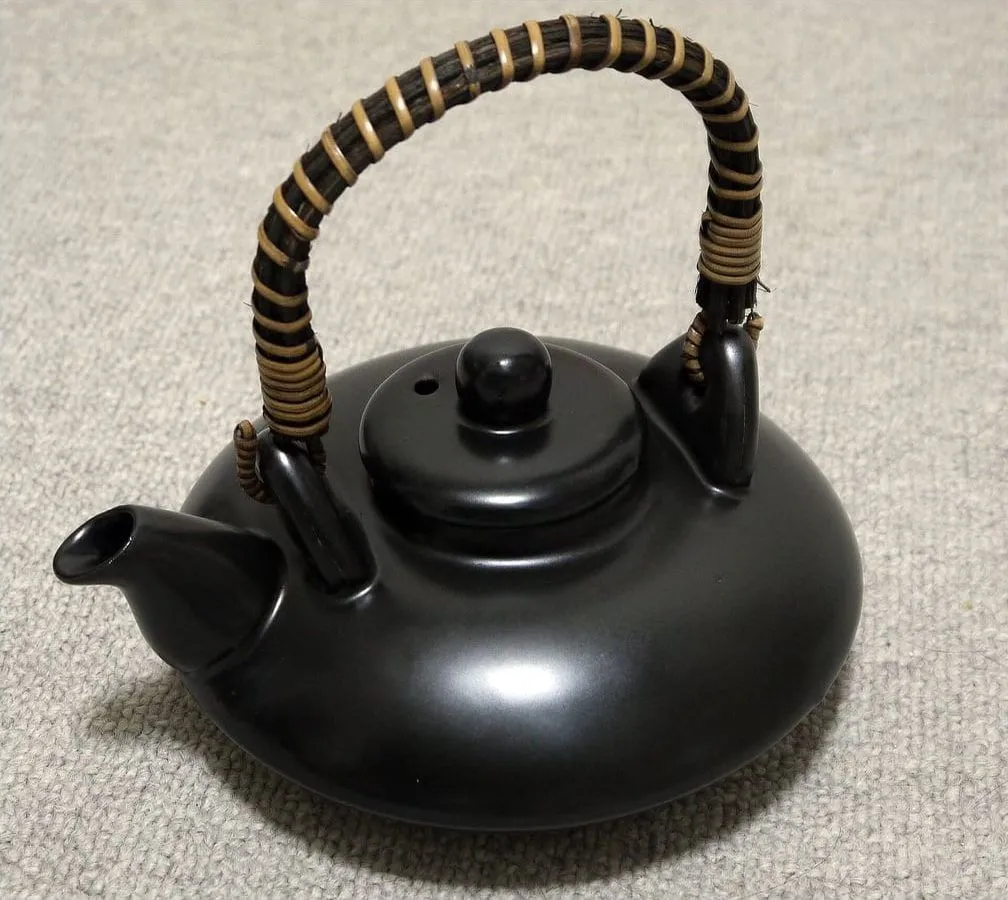
A story about the name is told by a Kagoshima potter's kiln, Chotaro-yaki. Its first master, Ariyama Chotaro, is said to have seen the silhouette of Sakurajima reflected in Kinko Bay and thought it looked like an abacus bead, which gave him the angular body of the pot. He named it 黒千代香 (kurojoka), meaning roughly "shochu that stays fragrant for generations". That is a tradition told by one source. The word choka itself has several proposed origins, such as the spout resembling a boar's tusk.
You pour the diluted shochu into the pot, set it over a low flame and warm it slowly, from body temperature up to a gentle warmth (one source puts nurukan at about 40 °C). Never heat it fast, one source warns, because the aroma escapes. Then it goes into small cups, and people pour for one another, a custom Satsuma Shuzo calls sashitsu sasaretsu. One distillery, Hamada Shuzo, says to dry the pot without washing it, so that the aroma soaks into the clay and it grows mellower with use.
Sometimes a cup called a sorakyu turns up at banquets: a cone-shaped cup that cannot stand up, so you must drink before you put it down. The name comes from "sora!" (there!) when it is poured and "kyu" for the gulp. Denen Shuzo says it was used in drinking games in southern Kyushu, where the loser drinks. Visitors should not feel obliged. Admiring the shape is enough.
Daiyame, the drink that ends the day
In Kagoshima you will hear the word daiyame. It is dialect for an evening drink to soothe the day's tiredness. The Kagoshima distillers' association and Hamada Shuzo describe it as a habit of drinking with family or friends, being thankful for a safe day and getting ready for tomorrow. A Kagoshima dialect dictionary says the word is a shift of dareyame, roughly "stop the fatigue". Similar words exist across Kyushu, and Miyazaki says dareyami. There is also an imo shochu named after it, by Hamada Shuzo: Daiyame 25%.
The oldest written "shochu" is a carpenter's complaint
Shochu has a long history here, and the oldest known written record of the word 焼酎 (shochu) is in Kagoshima too. It is a piece of wood with ink writing, found at Koriyama Hachiman Shrine in Okuchi, Isa City, during a repair in 1954. According to Kagoshima Prefecture, carpenters had written on a beam at the back of the main hall.
The date is the second year of Eiroku, 1559. The carpenters complained that the shrine's head priest who hired them was so stingy he never once treated them to shochu. The prefecture calls it the first appearance of the word 焼酎 in Japan. More than 460 years ago, a drink after work was already something people waited for. The piece of wood is a designated cultural property of the prefecture and is not on public display.
Choosing by the label
Most imo shochu here is made from a white-fleshed sweet potato variety called Koganesengan (黄金千貫), and the association says more than 40 varieties are used in total. Two terms on the label help when choosing.
- Koji. The Japan Sake Brewers Association's guide describes black koji as heavy and full-bodied, white koji as crisp and sharp.
- Distillation. Atmospheric-pressure distillation tends to give a weighty taste, vacuum distillation a cleaner one (from the Kagoshima association).
Here is what the labels actually say. We counted the 964 Kagoshima imo shochu in KIKI's catalogue (from 81 distilleries, as of 5 November 2026). Only what a label or the distillery states is counted.
| What we counted | Bottles | Share |
|---|---|---|
| Of 687 that name their koji: white koji | 319 | 46% |
| Of the same 687: black koji | 298 | 43% |
| Of the same 687: yellow koji | 43 | 6% |
| Of the same 687: a blend of koji | 27 | 4% |
| Of 336 that name the distillation: atmospheric | 308 | 92% |
| Of 519 that name the potato variety: Koganesengan | 285 | 55% |
White and black koji are close to even, almost all are distilled at atmospheric pressure, and more than half name Koganesengan. For the 800 with a current price, the median is ¥1,169 per 720 ml, an everyday drink when bought by the 1.8-litre bottle. (How we count: how our numbers work.)
Our guide to types of shochu and the Kagoshima region page go deeper.
Kagoshima food for shochu
- Satsuma-age (tsukeage): deep-fried fish paste. The Ministry of Agriculture gives two origin theories: one credits the lord Shimazu Nariakira, who had fish paste fried so it would keep in Kagoshima's humid climate, and the other points to Okinawan cuisine. Locals eat it all year, including as a snack with drinks.
- Torisashi (chicken sashimi): the skin is seared and the meat sliced thin, with shiso, garlic and ginger and a sweet soy sauce. The ministry ties it to samurai cockfighting. The Kagoshima food promotion site quotes a local history saying chicken was apparently eaten with imo shochu in the Edo period. Chicken served rare is not for everyone, so ask if you are unsure.
- Kibinago sashimi: a small silver fish, opened by hand and fanned out like a chrysanthemum, served with vinegar miso.
- Tonkotsu: pork spare ribs, first browned and then simmered with konnyaku, daikon, miso and brown sugar, with shochu used in the pot.
More ideas in food pairing with shochu.
How to order without feeling lost
- State the ratio. "Oyuwari, shochu six, hot water four." Say which one is six, and nothing gets mixed up.
- Ask about maewari. "Do you have maewari?" is enough.
- Ask for a kurojoka. One article says bars will serve it that way on request.
- Take it slowly. Nights are long in Kagoshima. Eat, take some water between glasses, and keep your own pace.
Drinking is for adults only (20 and over in Japan). If you meet a bottle or a menu you cannot read, KIKI, a free app that reads sake and shochu labels, can tell you what it is.
Sources
- 鹿児島県観光連盟 かごしまの旅「かごしまの本格焼酎を『味わう』」
- かごしま市観光ナビ「どうやって飲む?何がおススメ!?鹿児島焼酎完全攻略マニュアル!」
- 鹿児島県酒造組合「酒器と焼酎」
- 鹿児島県酒造組合「サツマイモと焼酎」
- 鹿児島県酒造組合「焼酎ができるまで」
- 鹿児島県酒造組合「本格焼酎バーが教える焼酎・基本の飲み方」
- 薩摩酒造「食文化について」
- 大口酒造 焼酎酒場くろいさ「焼酎がまろやかになる前割りって何だ?」
- たのしいお酒.jp「『前割り焼酎』ってどんな飲み方?」
- たのしいお酒.jp「黒千代香(くろぢょか)に魅せられて、鹿児島のつくり手たちに会いに行く(前編)」
- たのしいお酒.jp「『黒千代香(黒ぢょか)』とは?」
- 濵田酒造 伝兵衛蔵だより「本格焼酎を追求したらこうなった『鹿児島の酒器』」
- 濵田酒造「だいやめ~DAIYAME~特設サイト」
- 濵田酒造 公式note「焼酎のある生活に寄り添う、鹿児島の方言」
- 鹿児島弁ネット辞典「だいやめ」
- 宮崎県「だれやみ 宮崎焼酎について」
- 田苑酒造「黒千代香、そらきゅうって…?」
- 千代香 - Wikipedia
- 東串良町「『水割り、お湯割り、前割り』移住で知った鹿児島の焼酎文化の話」
- ウォーカープラス「焼酎の品ぞろえが豊富!鹿児島の地酒が楽しめる酒場」
- 本格焼酎と泡盛ガイド(日本酒造組合中央会)「焼酎の『黒』『白』『黄』の違い」
- 農林水産省「うちの郷土料理 つけあげ 鹿児島県」
- 農林水産省「うちの郷土料理 鶏刺し 鹿児島県」
- 農林水産省「うちの郷土料理 きびなごの刺身 鹿児島県」
- 農林水産省「うちの郷土料理 豚骨 鹿児島県」
- かごしまの食「鳥刺し 地鶏の刺身」
- Kagoshima Prefecture, "郡山八幡神社(伊佐市)" (the oldest written 焼酎)
- Isa City, "日本最古の「焼酎」文字記載墨書木片"
- KIKI, Kagoshima imo shochu data (as of 5 November 2026) and "How our numbers work"